 Places
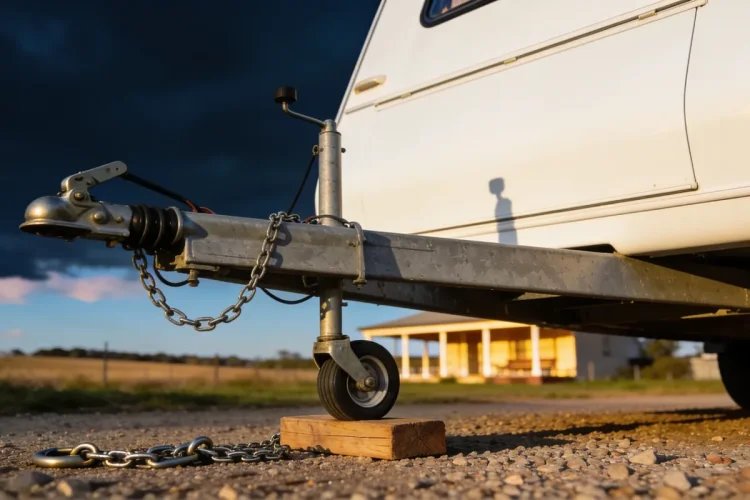
The van looked perfect in the photos. Island bed. Full ensuite. New-looking upholstery and a price that seemed fair for the size. You’ve already pictured it at a beachside caravan park in January.
Stop there. The layout is the last thing to look at. The first question is whether your car can legally tow that van once it’s loaded with water, gas, food and everyone’s gear. Plenty of buyers find out the answer at a weighbridge, or worse, on a highway in the wet. By then the money’s gone.
The good news is that the answer is written on the van. It’s on the van’s compliance plate, and it takes thirty seconds to read. Here’s what to read, what to check on your own car, and the checks that catch the expensive problems before you pay.
The Plate: Tare, ATM and What They Mean
Every caravan carries a compliance plate with its weights. Three numbers on it matter.
Tare is the van empty. That means the van as it left the factory with its standard equipment, but no water in the tanks, no gas, no food, no gear and no accessories added later.
ATM, the aggregate trailer mass, is the most the van is built to weigh fully loaded. Not the most it can carry. The most it can weigh, in total, with everything in it.
GTM, the gross trailer mass, is the weight sitting on the van’s own wheels when it’s hitched to your car. It’s the ATM minus whatever the tow ball is carrying.
Now do the sum that matters. Take the ATM and subtract the Tare. What’s left is everything you’re allowed to put in the van: water, gas bottles, batteries, the annexe, bedding, food, chairs and the kids’ bikes on the drawbar. Every litre of water is about a kilo, so full tanks eat that allowance quickly.
A van with a big gap between Tare and ATM is a van you can pack for a trip. A van with a small gap is a van you’ll be overloading the first time you take it anywhere. A small gap is a deal-breaker for most families. Walk away from it.
One more thing about the Tare. It’s the factory figure. Accessories fitted later, like a second battery, solar panels, a bigger awning or a spare wheel carrier, all add weight and all come out of your allowance. An older van with a list of extras may weigh a lot more empty than its plate says.
So before you drive out to look at anything, ask the seller for a clear photo of the plate. A seller who can’t or won’t send one has just saved you a trip.
Your Car’s Side of the Sum
The van is only half the equation. The other half is sitting in your driveway.
The NSW Government sets the rule plainly. A loaded trailer must not weigh more than the lesser of two numbers: the vehicle’s maximum towing capacity, and the rating of the towbar. Whichever is lower is your limit. If the vehicle maker hasn’t set a towing capacity, the NSW limit is 1.5 times the tow vehicle’s unladen mass, as long as the trailer has working brakes.
Find your car’s towing capacity in the owner’s manual. Check the towbar’s rating too, and ask the seller of the car or the fitter if you can’t find it. A heavy-duty car with a light-duty towbar is limited by the towbar.
While you’ve got the manual open, find the GCM, the gross combination mass. That’s the most your car and the loaded van can weigh together. It catches people out, because a car can be within its towing capacity and still be over its GCM once the car itself is loaded with passengers and gear.
Then there’s the tow ball. NSW guidance says that, as a general rule, about 5 to 10 per cent of the trailer’s loaded mass should sit on the coupling. Work out what that share is for the van you’re looking at, and check your car’s manual says it can carry that much on the tow ball.
Here’s my verdict. If the van’s ATM sits close to your car’s towing limit, don’t buy it. Close means no margin for a full water tank, a headwind or a long climb. Either find a lighter van, or accept that you’ll be changing the car as well, and price that in before you fall for the layout.
Other states set their own towing rules. The NSW figures here are a solid worked example, but check your own state’s version.
Brakes by Weight
Brakes are the next thing the plate tells you about, because the rules turn on the van’s weight.
In NSW, a trailer up to 750 kg GTM needs no brakes. From 751 kg to 2,000 kg, it needs brakes on both wheels of at least one axle. Over 2 tonnes GTM, it also needs an automatic breakaway system, which applies the van’s brakes if it comes off the car.
Read the GTM off the plate and you’ll know which rule applies. If the van has brakes, what you need to know is whether they work. On the test drive, hitch up and do a few stops at low speed. You should feel the van pulling up with the car, not shoving it from behind. If the van has a breakaway system, ask the seller to show you how it’s tested, and check the battery that runs it is charged.
If the seller won’t let you tow it, even around the block, ask why.
Water Damage: The Check That Saves the Most Money
This is where used caravans hide their biggest bills. Water gets in through a tired seal, soaks into the timber frame and floor, and does its damage quietly for months before anyone notices. By the time it shows, the repair can involve pulling walls apart.
You can find a lot of it with your hands and your nose.
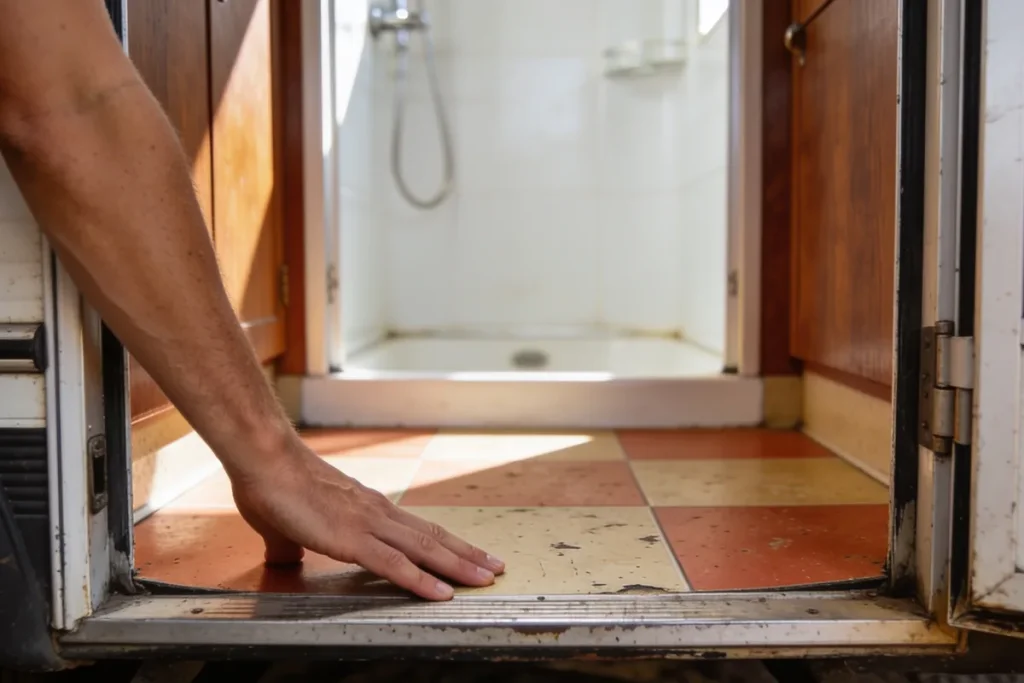
Press the floor. Walk the whole van and press down with your hand in the spots where water likes to sit: near the entry door, around and under the shower, in front of the kitchen sink, and at the front boot. Solid is good. Soft, spongy or bouncy is bad.
Check the seals. Look at every window seal, roof hatch, roof join and corner trim. Cracked, shrunk or freshly gooped sealant all tell you something. Fresh sealant on one corner and old sealant everywhere else is a question worth asking.
Look up. Check the ceiling for stains, sagging or patches of fresh paint, especially near hatches and vents.
Press the outside walls. Run your hand along the outer skin and press gently. Bubbling, rippling or a wall that moves under your hand can mean delamination, where the skin has come away from the frame underneath.
Smell it. Ask to have the van closed up for a while before you arrive, then step in and breathe. A musty, damp smell is hard to hide and hard to fix.
On anything expensive, go further. Borrow or buy a moisture meter, or pay for an inspection. Either costs less than a rebuilt floor. Product Safety Australia names caravans among the items worth inspecting first or getting an expert’s advice on before you buy. For a purchase this size, I’d take that advice.
If you find soft floors or a damp smell and the seller shrugs it off, walk away. You’ll find another van. You won’t find the money to fix this one.
Paperwork: PPSR, Rego and the Seller
A great van with finance still owing on it is not a great van. It’s someone else’s debt.
Run a PPSR search using the van’s serial number, its VIN or chassis number. It costs $2 online and caravans and trailers are covered. The search shows whether there’s a registered security interest on the van, which usually means finance owing. It also shows stolen or written-off flags from state data. It won’t tell you how much is owing or who has owned the van before. Do the search when you first find the van, and do it again on the day you pay, because things can change in between.
Then the transfer. The rules are set by each state:
- Queensland: the seller provides a current safety certificate, and the buyer finalises the transfer within 14 days.
- Victoria: the seller completes a notice of disposal within 14 days, and VicRoads says that covers trailers and caravans as well as cars.
Check your own state’s version if you’re elsewhere.
Last, the seller. Scamwatch is blunt about it: don’t pay for a caravan before you’ve inspected it in person. No deposits to “hold” a van you’ve only seen in photos. No transfers to someone who says they’re interstate and will have it delivered. If you can’t stand next to it and press the floor, you don’t pay for it.
What a Private Seller Owes You
Buying privately is cheaper than buying from a dealer for a reason. You get less protection.
The ACCC says most consumer guarantees don’t apply to a one-off sale by a private seller. If the fridge dies a week later, that’s generally on you. A few things do still apply: the seller has to own the van and have the right to sell it, you’re entitled to keep it without someone else claiming it, and it has to come free of hidden debts.
That last one is the reason the $2 PPSR search matters so much. It’s the one check that lets you confirm the protection you’re actually owed, before you hand over the money rather than after.
Weigh It Before You Want It
Read the plate first. Know the Tare and the ATM, do the subtraction, and walk away from a van with no room to pack. Check your car’s towing capacity, its towbar rating and its GCM, and leave yourself a margin. In NSW, know which brake rules apply to the van’s weight, and test the brakes on a drive.
Then go looking for water with your hands and your nose. Run the PPSR search twice, sort the transfer by your state’s rules, and never pay for a van you haven’t stood in. Do the numbers before you let yourself love the layout.
Sources: NSW Government, Towing a trailer or caravan (https://www.nsw.gov.au/driving-boating-and-transport/roads-safety-and-rules/vehicle-safety-and-compliance/towing-a-caravan); PPSR, Do a used car or vehicle search (https://www.ppsr.gov.au/carcheck); Scamwatch, Buying and selling scams, 2026 (https://www.scamwatch.gov.au/types-of-scams/buying-or-selling)


