 Places
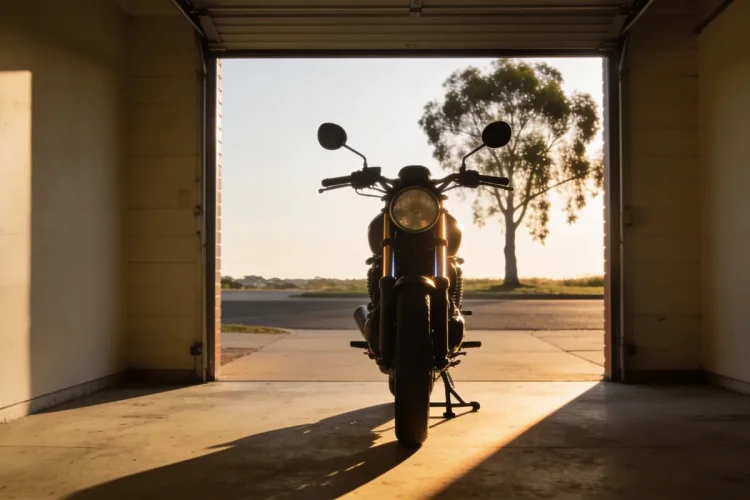
You’ve got your savings in the bank, your learner permit in your wallet and a dozen listings open on your phone. Every one of them says “runs perfect”. You pick the cleanest, drive across town, and when you walk into the garage the bike is already ticking over, warm, ready to go. The seller says he started it so you wouldn’t have to wait. Thank him, and walk away. A warm engine hides the very things you came to check. The bike that’s right for you will be cold when you arrive, with a chain that’s been looked after and fork legs that are dry, and if you’re on your Ls, it’ll be on your state’s approved list in the exact form it left the factory. Here’s how to check all of that in half an hour.
Used motorbike inspection
0 of 15Ask the seller not to start the bike before you arrive.
Learner and LAMS
Engine and running gear
Paperwork
Your own checks, not a roadworthy inspection.
LAMS First, If You Are a Learner
If you’re on your learner or restricted licence, this check comes before anything mechanical. A perfect bike you can’t legally ride home is no use to you.
Every state runs a Learner Approved Motorcycle Scheme, or LAMS, and keeps a list of bikes learners and restricted riders are allowed on. Victoria’s Department of Transport and Planning sets out what a bike has to be to qualify there, and it’s a good picture of how the rules work:
- it must be in standard form, as produced by the manufacturer;
- it must not be modified to increase its power-to-weight ratio;
- its power-to-weight ratio must be 150 kW per tonne or less;
- bikes over 660cc are not approved.
Victoria also says plainly that its list is updated over time and is not exhaustive. So you check the specific model and year, and you check it against your own state’s list, because other states run their own.
Now the part sellers skip. Look hard at the exhaust, the intake and anything that suggests an ECU tune. Riders say it on forums often enough: plenty of LAMS bikes for sale have been modified. An aftermarket pipe or a tune that adds power can take a bike out of the standard form the rules ask for. Then it’s a bike a learner can’t legally ride, whatever the original model says.
Ask the seller straight: “Has anything been changed from standard?” If the answer is a list, and you’re a learner, keep looking. Don’t take the seller’s word that it’s “still LAMS”. Check it yourself.
There’s a selling angle too. You won’t be on your Ls forever, and when you move up, the next buyer is probably another learner. A standard, unmodified LAMS bike is an easy sale to that person. A loud pipe and a tune make it a hard one.
Cold Start
When you message about the bike, ask the seller not to start it before you arrive. Say it plainly. If you get there and the engine’s warm anyway, walk away.
A cold engine tells the truth. Starting problems, rattles that fade as things warm up, smoke that clears once the oil is hot: a warm engine covers all of it.
Put your hand on the engine or the exhaust before anything happens. Cold? Good. Then let the seller start it, or start it yourself.
- Choke or fuel injection. An older carburettor bike may need the choke and a little coaxing. A fuel-injected bike should start without much fuss. Either way, it should catch and settle, not crank on and on.
- Smoke. A puff on a cold morning can be normal. Heavy smoke, or smoke that keeps coming, is not.
- Noise. Listen at idle for knocking, ticking or rattles. Some engine noise is normal for some bikes. A metallic knock is not.
- Idle. It should settle into a steady idle as it warms. Hunting up and down, or stalling, means something needs sorting.
While it warms up, look underneath. Fresh oil drips under the engine, or a wet patch under the radiator on a liquid-cooled bike, mean something is leaking. Look at the drip tray or the concrete where the bike usually sits, too. A stained patch on the floor says the leak isn’t new.
If it won’t start cold, or starts and sounds sick, that’s your answer. Don’t let anyone talk you into “it just needs a ride”.
Chain and Sprockets
This is my favourite check, because it tells you about the owner as much as the bike.
A chain needs regular cleaning, lubing and adjusting. It’s a small, boring job. An owner who skips the boring job has probably skipped others you can’t see, like oil changes and valve clearances. One rider summed it up on a forum: if somebody isn’t keeping the chain right, they’ve likely been neglecting more serious, less visible stuff.
Here’s what to look at:
- Slack. Push the chain up and down at the middle of the bottom run. It should move a little, not hang loose and not be bar tight. The owner’s manual gives the right range for that model.
- Rust and stiff links. Roll the bike forward slowly and watch the chain go around. Orange rust, dry links, or links that stay kinked instead of straightening out all mean neglect.
- Sprocket teeth. Look at the rear sprocket. The teeth should be even and squared off. Teeth that are hooked or pointed like a wave mean the sprocket and chain are worn out.
A worn chain and sprockets aren’t the end of the world. They’re a set, and they get replaced together. But they’re a cost, they’re a bargaining point, and they’re evidence. A rusty, saggy chain on a bike described as “well looked after” tells you how much the rest of the ad is worth.
Fork Seals and Suspension
Crouch down at the front wheel and look at the fork legs, the chrome tubes that slide into the bottom of the forks.
They should be clean and dry. Oil on the tubes, a ring of grime at the seal or wet dirt stuck to the lower legs all mean the fork seals are leaking. Leaking seals let oil out, and oil out means worse damping. Worse, oil from a fork seal can find its way onto the brake.
Wipe a finger around the tube just above the seal. If it comes away oily, the seals need doing.
Then the bounce test. Stand beside the bike, grab the front brake and push down hard on the bars a few times. The front should compress smoothly and come back up without bouncing or clunking. A pogo-stick bounce means tired damping. A clunk can mean worn parts, or something loose in the steering head.
Go to the back. Look at the rear shock for oil on the body or the shaft. Push down on the seat and let it go. Same rule: smooth down, smooth back, no bounce.
Fork seals and shocks can be fixed. Price that into your offer. What you don’t do is accept “they’ve always looked like that”.
Crash Signs
Everybody drops a bike sooner or later. What you want to know is how hard, and whether it’s been fixed properly or just tidied up for the photos.
Walk around the bike slowly, low down, and look at the bits that hit the ground first:
- Bar ends. Scraped or ground flat.
- Levers. Bent, snapped short, or brand new when the rest of the bike isn’t.
- Footpegs. Scraped, bent or replaced with odd ones.
- Fairings and panels. Scrapes, cracks, or panels that don’t match in colour or fit. A new panel on one side only is a question.
- Handlebars. Sit on the bike and look down. Do the bars line up with the front wheel? Bent bars are a sign of a decent hit.
- The tank. Run your hand along it. Dents often come from a fall, or from the bars swinging round on full lock.
One scrape on a lever is a drop in the driveway. Scrapes on both sides, new panels, bent bars and a dented tank add up to something else. Ask how it happened. If the story doesn’t match the marks, walk.
Tyres, Brakes, Battery and Wiring
Four quick checks, and none of them should be skipped.
Tyres. Check the tread depth across the whole tyre, not just the middle. Then find the date code on the sidewall. Old tyres go hard and lose grip even with tread left on them. Cracks in the rubber mean replace.
Brakes. Look at the discs for deep grooves or a lip around the edge. Look at the pads through the caliper and check there’s material left. On the test ride, check the front and rear both pull the bike up smoothly.
Battery. Ask how old it is. A slow crank on the cold start already told you something.
Wiring. Pull the seat off. Look for tidy factory wiring. Electrical tape, joined wires, extra wires to nowhere or a melted connector all mean someone’s been in there. Sometimes that’s a neat accessory install. Sometimes it’s a fault being patched. Either way, ask.
Then the test ride. If the bike isn’t registered, you can’t legally take it on the road, which means no test ride. Walk away, or factor that in. And only ride it if your licence allows you to.
On the ride, use every gear. Each one should click in cleanly, without crunching or jumping back out. Roll on the throttle in a higher gear and watch the revs: if they climb and the bike doesn’t pick up speed with them, the clutch is slipping. On a straight, quiet stretch, ease your grip on the bars for a moment. The bike should run straight, not pull to one side. Come back and look underneath again, now that everything is hot.
Paperwork
Mechanically sound isn’t enough. You also need to know it’s the seller’s to sell.
- PPSR search on the VIN. Do it before you pay. It tells you whether money is owed against the bike and whether it’s been reported stolen or written off.
- Rego papers. Check the name and address match the seller.
- Matching numbers. The VIN on the frame should match the papers and the PPSR search. If it’s been ground off or doesn’t match, walk.
- A receipt. Both names, the VIN, the price and the date. Both of you sign it.
- Transfer. Your state sets a deadline for transferring registration. Check yours and get it done in time.
Do the PPSR search when you first find the bike, then do it again on the day you hand over the money. Things can change in between, and it takes a few minutes online.
Pay in a way that leaves a record, and pay only when you’re standing next to the bike with the keys and papers in your hand. No deposits to “hold” a bike you haven’t seen.
A seller who won’t let you see the VIN or the rego papers has told you what you need to know.
Cold, Clean, Legal, Then Cash
Turn up to a cold engine and walk away from a warm one. Check the chain and sprockets, and read them as a report on the owner. Look for dry fork legs and a smooth bounce. Get down low for crash marks, then check the tyres, brakes, battery and wiring.
If you’re a learner, check the model and year against your state’s LAMS list and walk away from anything modified to make more power. Run the PPSR search, match the numbers, and get a receipt with both names on it.
Do all of that and you’ll ride home on a bike worth the money. Skip it and you’re paying for the seller’s story.
Sources: Department of Transport and Planning (Victoria), Motorcycles for learner and restricted riders (https://transport.vic.gov.au/road-rules-and-safety/motorcycles/motorcycles-for-learner-and-restricted-riders)


