 Places
Say a buyer weighs your old chain and offers a number per gram. Is it a good number? You can’t tell, because you have nothing to hold it against. That is the whole problem, and you can fix it at your kitchen bench before you go anywhere.
Here is our position, plainly. Work out your own melt value first: weight, carat and the day’s gold price. Then treat every quote as a percentage of that number. A buyer paying below melt on jewellery is normal. It isn’t a scam. On 11 November 2026 the Perth Mint’s published jewellery buying rate worked out at about 77.5 per cent of its gold spot bid, at every carat. Its published rate for a one-ounce gold coin worked out at about 97.8 per cent. Same metal, same minute, a gap of twenty points.
Know the limits of that number. It is one buyer on one day, and the percentages are our calculation from two of its price pages, not a figure the mint states. No official “fair percentage” exists, and we won’t make one up. What you get here is a method that works on any quote from any buyer, and the one dated benchmark we could pin to a primary source.
Sort and Weigh Before You Go
Start with a tray and a clear bench. Sort every piece by the stamp. The numbers you want are 375 (9 carat), 585 (14 carat), 750 (18 carat) and 916 (22 carat). A 999 stamp is fine gold. The Perth Mint’s own guidance lists the same fineness figures, and notes that 9 carat is 37.5 per cent gold and 18 carat is 75 per cent.
Then set aside what has no melt value at all. Plated pieces, gold-filled pieces and costume jewellery are not solid gold, so a gold buyer has nothing to pay for. So are steel springs, pins and any clasp that isn’t stamped. Don’t carry that pile into a shop and hope. Here is where plated or costume pieces can go instead.
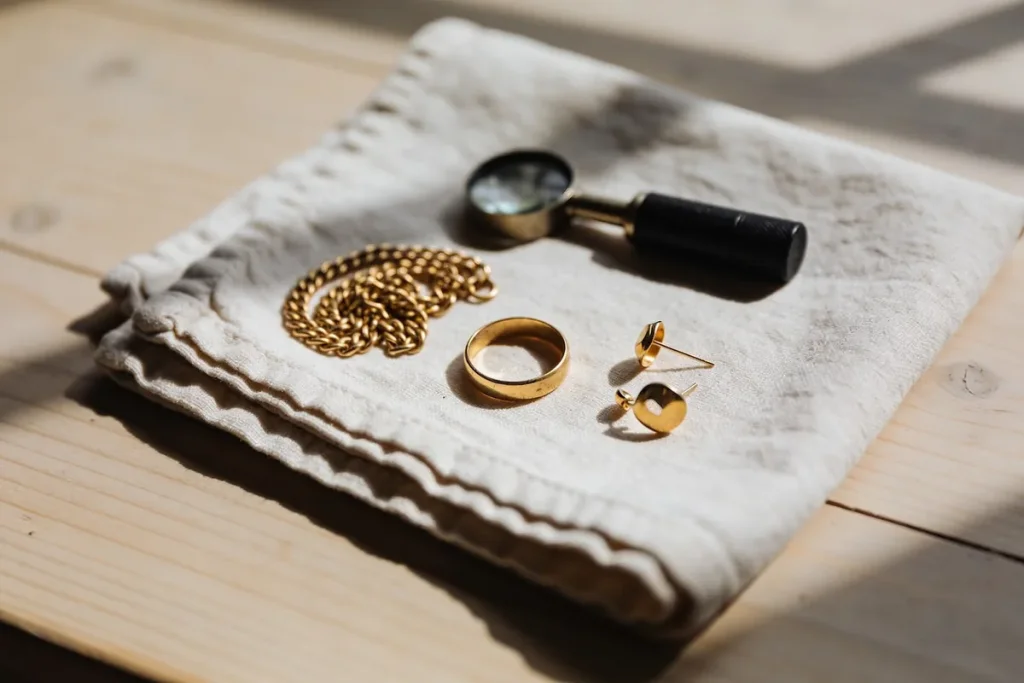
Weigh what is left, in grams, and write each carat group’s weight down. A kitchen scale will give a rough number. A jewellery scale reading to 0.1 g is better, because a few grams is real money here.
Two things to know. First, stones. They add weight that isn’t gold, and the Perth Mint’s page says deductions may apply for items with gemstones or other non-metal parts. Second, the buyer’s weight is the one that counts. You can’t control their scale, but you can ask to see the figure read out before they quote. Do that with every buyer.
The Price Behind Every Quote
Gold is priced per troy ounce, and the price should be in Australian dollars when you check it. One troy ounce is 31.1035 grams. A buyer’s screen shows two prices: the bid, which is what the market will pay, and the ask, which is what it charges. Your gold is being bought, so the bid is the one to use.
Here is the reading we used. The Perth Mint’s metal prices page, read on 11 November 2026 at 5:24 PM AWST, showed a gold spot bid of A$5,872.18 per troy ounce, with the ask at A$5,924.09.
The sum is two steps. Divide the ounce price by 31.1035 to get the price of a gram of pure gold: 5,872.18 divided by 31.1035 is about A$188.79 per gram. That figure is derived by us, not published by the mint. Then multiply by the carat’s fineness to get the melt value of a gram of that carat.
| Carat | Fineness | Melt per gram (gram price of about A$188.79 x fineness, unrounded) |
|---|---|---|
| 9ct | 375 (37.5%) | $70.80 |
| 14ct | 585 (58.5%) | $110.44 |
| 18ct | 750 (75%) | $141.60 |
| 22ct | 916 (91.6%) | $172.94 |
| 24ct | 999 | $188.61 |
Gold moves every day, sometimes by the hour. These figures are the 11 November reading and will be out of date when you read them. Use the table as the method, then put today’s spot bid into your own sum.
A Worked Lot
Take a hypothetical lot, made up for this example and belonging to nobody. A 9 carat chain at 12.0 g, a plain 18 carat band at 4.5 g and a pair of broken 9 carat earrings at 3.0 g, all weights stone-free.
| Piece | Weight | Melt per gram | Melt value |
|---|---|---|---|
| 9ct chain | 12.0 g | $70.80 | $849.60 |
| 18ct band | 4.5 g | $141.60 | $637.20 |
| 9ct earrings | 3.0 g | $70.80 | $212.40 |
| Total | 19.5 g | $1,699.20 |
That is 19.5 g of jewellery holding 9.0 g of pure gold, with a melt value of $1,699.20 on the 11 November reading. Here is what a quote looks like as a share of that.
| Offer as a share of melt | Offer on this lot |
|---|---|
| 50% | $850 |
| 60% | $1,020 |
| 70% | $1,189 |
| 77.5% | $1,317 |
| 85% | $1,444 |
| 90% | $1,529 |
Each percentage point on this lot is about $17. So the gap between a 70 per cent offer and an 85 per cent offer is roughly $255. That is the money you are negotiating over. Keep it in your head in points, not dollars, and the arguing gets a lot easier.
Now the other direction. Say a buyer, from nobody in particular, quotes $30 a gram for your 9 carat pieces. Divide $30 by the $70.80 melt per gram and you get about 42 per cent. Whether that is acceptable is your call. At least now it is a call you can make with a number in your hand.
What a Normal Quote Looks Like
A common view among sellers online is that dealers pay for the weight of the gold, not for design or sentiment. We agree, and it is the frame for everything here. A chain your grandmother wore every day and a chain from a bargain bin are the same to a melting pot if they hold the same gold.
Dealer pages and general guides often say to expect somewhere between 70 and 80 per cent of spot at a reputable buyer. That is marketing copy unless something checks it, so we checked it against the one primary source we could find. The Perth Mint’s price pages on 11 November 2026, read at the same minute, list a buying price for hallmarked jewellery of $54.87 a gram for 9 carat, $85.59 for 14, $109.74 for 18, $134.03 for 22 and $146.17 for 24. Set each against that carat’s melt value from the table and you get 77.5 per cent. Its price for a one-ounce gold coin is $5,740.06, which is 97.8 per cent of the spot bid, and bullion from other mints is listed at $5,718.93, or 97.4 per cent.
So on that day, at that buyer, the dealer rule of thumb happens to hold. We would not stretch it further. The page calls its prices indicative only and says they are finalised in store. It does not say how the jewellery figure is set, so we say it “works out at” 77.5 per cent and never that the mint takes a cut. Other buyers publish other rates. That is the reason to get more than one quote.
Why would jewellery pay less than a coin? The mint doesn’t say, but the shape of it is easy to see. A coin is a known weight and purity in a standard form. Jewellery has to be tested, sorted and processed, and the buyer has costs to cover. The Perth Mint’s own seller guidance says it plainly: all gold buyers will offer you a price somewhat below the headline rate. Expect that. It isn’t a trick.
Online, readers split on where to sell. Some favour specialist buyers who publish their rates, others call pawn-style and cash-converter shops lowballers. We name no business and rank none, because the shop type tells you less than the number does. Take the rate per gram for your carat, divide by the melt per gram for that carat, and you have a percentage. Two buyers quoting in different formats become comparable the second you do that.
The other side has a fair point. A dealer’s rate is a scrap rate. If you own a distinctive, branded or well-made piece, you may do better selling it privately or through a jeweller who sees a piece and not metal. That isn’t a reason to avoid dealers, but it is a reason to know which kind of piece you hold. For a broken chain and odd earrings, weight is the whole story.
Getting Two or Three Quotes
Get them on the same day, because the price moves. Take the same pieces in your hand each time, so you’re comparing like with like. Ask each buyer for the rate per gram for each carat, and whether the quote holds if you come back, or only while you stand there.
Don’t let anyone pool the lot. If a buyer offers one figure for everything, ask for it broken down by carat and weight. Pooling makes the percentages impossible to check.
Ask whether it is a sale or a loan. Pawn-style businesses do both, and the paperwork differs. And check how you will be paid. The Perth Mint’s page, for example, says it pays only into an Australian bank account in your name.
The habit is the same one you’d use when comparing sale routes on what you actually keep after selling a car: the headline number is not the number you take home, so line up what each route really pays you, then choose.
Licence, ID and the Hold
Many gold buyers trade as second-hand dealers or pawnbrokers, and those businesses carry rules. They differ by state, so read this as a guide and check yours.
In New South Wales, the Pawnbrokers and Second-hand Dealers Act 1996 applies. The NSW Government’s page says a dealer must check the supplier’s identity (an Australian driver’s licence, an Australian passport, or a foreign passport with proof of address). The seller completes an ownership statement and records are kept for three years. The page lists a 14-day hold for “regulated goods” but doesn’t say whether gold or jewellery counts, so ask the dealer what applies.
In Queensland, a dealer must be licensed and must check seller ID showing name and address, then record it with whether you own the goods and how you got them. Jewellery and precious metals are “nominated goods”, held for 7 working days. A dealer must not accept goods from anyone who is, or seems, younger than 17.
In Victoria, anyone carrying on the business of buying second-hand goods must be registered, regardless of where the goods are bought. Consumer Affairs Victoria keeps a public register. In Western Australia, second-hand dealers are governed by the Pawnbroker and Second-Hand Dealer Act 1994, and the WA Police Force page covers the licence. Other states and territories run their own licences, so check yours. Whichever state you are in, ask to see the licence or registration before any pieces leave your hand.
Why does the paperwork exist? It’s the same reason stolen goods rules shape how dealers record what they buy: a buyer has to be able to show where goods came from. So treat a request for ID as a good sign. In NSW and Queensland a dealer who doesn’t ask is not following the state rules, and that is a reason to walk. The Perth Mint shows the strict end: in-store trading only, an account with 100 points of ID, photo ID at each visit, and hallmarks required or it may refuse the piece.
Tax and Paperwork
CPA Australia says collectables bought for more than $500, jewellery included, are treated as CGT assets. So keep your records: receipts, valuation certificates, inheritance paperwork and anything that shows what the piece cost or was worth when you got it. If you ever need to work out a gain, that paper is what you’ll need. For how the rules apply to what you hold, check with the ATO or a registered tax agent. This is not tax advice, and we are not saying whether you owe anything.
Walk In With Your Number
Sort by stamp. Weigh in grams. Multiply by the day’s spot bid and the carat’s fineness. Then turn every quote into a percentage of that number.
A below-melt quote is normal. The one dated benchmark we could find puts a published jewellery rate at about 77.5 per cent of spot on 11 November 2026, one buyer, one day. It is not a promise or a ceiling. It shows the gap between melt and a quote is something you can measure and shop around.
Two quotes you can compare beat one you have to trust. If the numbers don’t work, walk out, the same as you would from a dodgy deal over a ute full of tools. Have your number ready before you speak to anyone.
Sources: Perth Mint, Live gold, silver, platinum prices (https://www.perthmint.com/invest/information-for-investors/metal-prices/); Perth Mint, Sell your gold jewellery (https://perthmint.com/visit/buy-sell-gold/sell-your-gold-jewellery); Perth Mint, Top tips for selling gold (https://www.perthmint.com/news/investor/investor-knowledge/top-tips-for-selling-gold2/); NSW Government, Pawnbroker and second-hand dealer business obligations (https://www.nsw.gov.au/business-and-economy/running-a-business/industry-specific-business-requirements/pawnbrokers-and-second-hand-dealers); Queensland Government, Legal requirements for second-hand dealers and pawnbrokers (https://www.qld.gov.au/community/fair-trading/regulated-industries-licensing-and-legislation/second-hand-dealing-and-pawnbroking-industry-regulation/legal-requirements); Consumer Affairs Victoria, Apply for registration and endorsement (https://www.consumer.vic.gov.au/licensing-and-registration/second-hand-dealers-and-pawnbrokers/registration/apply-for-registration-and-endorsement); WA Police Force, Pawnbroker or second-hand dealer licence (https://www.wa.gov.au/organisation/western-australia-police-force/pawnbroker-or-second-hand-dealer-licence); CPA Australia, New CGT rules could force Australians to value everyday collectibles (https://www.cpaaustralia.com.au/about-cpa-australia/media/media-releases/new-cgt-rules-could-force-australians-and-their-accountants-to-value-everyday-collectibles)


