 Places
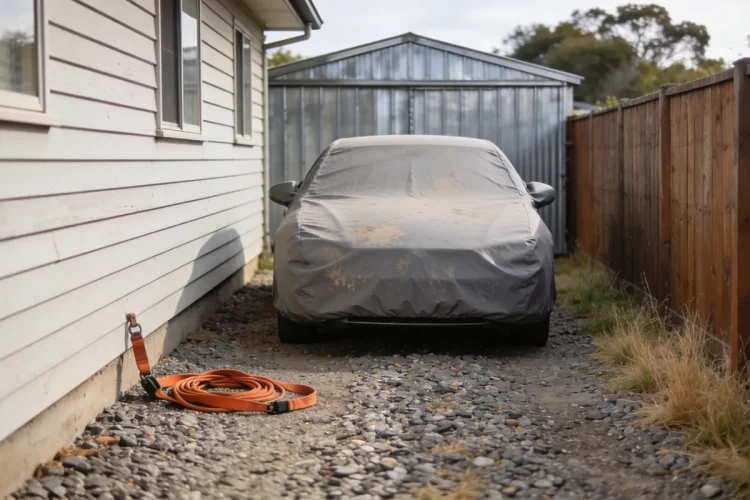
The ad reads: “Unregistered, no rego, buyer to collect.” It is a common line in car listings, and it hides two separate jobs. The first is the sale: agreeing a price, handing over the keys and leaving a paper trail. The second is getting a car with no registration off the seller’s driveway and onto a trailer, a tow truck or a road, and that job has its own rules.
We think the two should be kept apart. Selling an unregistered car can be a simple transaction. Queensland’s own transport page says it can be done without a safety certificate. Moving it is the hard part. It takes a state-issued permit for one stated journey, bought where the trip starts, or a tow truck, and the few permit-free trips that exist do not cover “to the mechanic” or “to the wrecker”. The seller’s job is to say how the car will leave before the buyer pays.
One boundary on this post before we start. We could read the official permit pages for New South Wales, Queensland and Western Australia, and this guide covers those three only. Victoria, Tasmania, the Northern Territory, South Australia and the ACT were not opened, so nothing below is a statement about them. Each state and territory issues its own permit, and if you are in one of those places, check your own transport authority’s page before you list or move a car.
Selling It and Moving It Are Two Different Jobs
Start with the sale. Queensland’s Selling and moving unregistered vehicles page, last updated in July 2015, says an unregistered vehicle can be sold without a safety certificate. Once the buyer has inspected the car and agreed to buy, the page says to create a paper trail. That means a signature from the seller and the buyer, the VIN, chassis number or engine number, the make and model, and the date of sale. In most cases, it says, a simple contract, receipt or carbon-copy receipt is acceptable if it lists those items, and each side keeps a copy. It adds that sellers and buyers both have a responsibility when the sale takes place.
That is the sale side, and it is the only sale rule we can source. Other states set their own sale and transfer rules, and the registration state of the buyer decides what inspection the car needs. We are not making any claim beyond Queensland here, and in particular we are not saying that a safety or roadworthy certificate is unnecessary anywhere else. Check your own authority.
What the sale does not do is move the car. A signed receipt does not make an unregistered vehicle legal to drive, and it does not put a tow truck on the street. Once the buyer has paid, the car is still sitting there, and someone has to take it away. That someone needs either a permit or a tow, and settling which before the sale saves an argument afterwards.
What a Permit Actually Buys You
A permit is not a registration. All three states describe it as permission for one purpose, for a short time, on a stated route.
In Queensland the permit is issued for 1 to 7 days, valid from 12.01am on the first day to midnight on the last, for the most direct route. The vehicle must be in a safe condition and the driver must carry the permit. The number plates must be detached while the vehicle is moved under a permit. Class 22 compulsory third party insurance is needed as well, and it costs extra on top of the permit fee. Without a permit, a fine is possible.
In New South Wales the unregistered vehicle permit (UVP) lets you drive for a specific journey and is valid only for the time needed by the most direct route. Service NSW states that permits are not issued to cover extra days, and that a UVP cannot substitute for full registration.
In Western Australia the temporary movement permit lasts 48 hours from the nominated start time. It works differently on insurance: the permit is itself a Motor Injury Insurance policy. That covers injury liability, not damage to property or to the vehicle, which is a distinction worth knowing before anyone drives.
So a permit buys one journey. It does not buy a few days of running errands in a car with no registration, and it does not make the car roadworthy.
Three State Pages Side by Side
The table below sets out what the three issuing pages say. It is built from the pages themselves: the Queensland Government pages (the permit page last updated in July 2025), Service NSW (last published 19 June 2026), the NSW Government’s page on when you can drive an unregistered vehicle, and Transport WA. We have left fees out on purpose. They are set by each authority and change from time to time, so read the figure on the issuing page when you apply.
| New South Wales | Queensland | Western Australia | |
|---|---|---|---|
| Permit name | Unregistered vehicle permit (UVP) | Unregistered vehicle permit | Temporary movement permit |
| How long it lasts | The time needed for the most direct route; a multi-stop trip over several days is capped at 28 days | 1 to 7 days, from 12.01am on day one to midnight on the last day | 48 hours from the nominated start time |
| Journeys covered | Single A to B, return, A to B to C to D over several days, NSW to interstate, interstate to NSW | Buying an unregistered vehicle and moving it, towing, repair when safe to move, taking it home after refused registration, moving it interstate for registration | To an inspection for licensing, to a place of repair before licensing, to another jurisdiction for licensing |
| Who is refused | Written-off vehicles are not eligible | Several cases, listed under “Who a Permit Will Not Move” below | Moves for parts or wrecking |
| Plates | Old plates returned when you apply if still on the vehicle; if registration is expired but not cancelled, plates need not be returned but must be removed before driving | Detached while the vehicle is moved; a permit is not issued if plates are still attached | Not compulsory to display number plates on a vehicle under a temporary movement permit, but the VIN or chassis number must be quoted if there are no plates |
| Insurance | Not stated on the pages we opened | Class 22 CTP needed, at extra cost | The permit is a Motor Injury Insurance policy (injury only) |
A note on why they differ. Each state sets its own permit, issues it through its own authority and writes its own limits. A rule read from one state page cannot be carried across the border, so read the page of the authority where the car will start its journey.
When the Car Crosses a Border
Interstate sales are common in car classifieds, and the three pages do not say the same thing about them.
Queensland’s page says a permit must be purchased from the state or territory where the journey starts. It also says a Queensland-issued permit can be used throughout Australia, except in some circumstances in Western Australia, and that a person who normally lives in WA needs a Queensland permit to the WA border and then a WA permit. Transport WA says the same from its side: where the person responsible for a vehicle is a WA resident, an interstate permit will not be recognised and a WA permit is needed.
Queensland’s page also says a permit cannot be issued for a vehicle being moved into Queensland from interstate. Service NSW, meanwhile, lists “interstate to NSW” among the journey types a UVP can cover.
Those two statements do not obviously match. We are not going to rule on which one wins, because it depends on where the car starts and which authority is issuing. If the car is crossing a border, confirm with the issuing authority before you book the move, and ask them in writing if it is not clear.
When You Do Not Need a Permit, and Why “To the Mechanic” Is Not a General Exemption
It is tempting to assume an unregistered car can be driven to the mechanic, or just around the corner. The official pages say something narrower.
Queensland lists the trips that need no permit for a drive or a tow, and says they are for these purposes only: a gas certificate, a weighbridge certificate, a safety certificate or certificate of inspection (including a road test), a written-off vehicle inspection (for repairable write-offs only), a police inspection, surrogate identification number stamping, or applying for registration at the nearest customer service centre. Moving the car for repair, or to its annual inspection before renewal, needs a permit unless an extension of time has been arranged.
New South Wales gives a similar list. Without a UVP, an unregistered vehicle may be driven by the most direct or convenient route to the nearest convenient service centre or authorised inspection station, during the inspection or test, to the nearest weighbridge, and to a licensed CTP insurer. Where registration was refused, it may also go to the nearest convenient place for necessary repairs or garaging. The page puts the dividing line in one sentence: if you need to make trips in an unregistered vehicle and are not getting repairs, insurance or registration, you must apply for an unregistered vehicle permit.
Both lists are about the registration process, not everyday errands. Neither covers a trip to a mechanic of your choice for its own sake, a mate’s yard or a wrecker. In Queensland, repairs need a permit unless an extension of time has been arranged. In New South Wales a repair trip is on the permit-free list only after a service centre has refused registration or after the vehicle has been to an authorised inspection station.
We side with the official pages. A seller who tells a buyer to just drive it round is passing on a rule neither page supports.
Who a Permit Will Not Move
A permit is refused for several kinds of vehicle, and for a seller this list matters more than the permit itself, because it decides whether a permit is even available.
Queensland’s page lists the cases in which a permit cannot be issued. These include a vehicle that is not safe to drive or has failed a safety inspection, one that still has number plates attached, one that is being moved to Queensland from interstate, one with no VIN or chassis number, and one with no compliance plate or Register of Approved Vehicles entry. A vehicle subject to a serious unresolved manufacturer defect recall, such as an airbag recall, cannot get one either, nor can one under a plate confiscation notice, one carrying a load for hire or reward, or one that is written off and needs to be moved (including to get a written-off vehicle inspection). The page lists a few other cases besides. It says an unsafe vehicle needs a tow truck.
New South Wales states that written-off vehicles are not eligible. Western Australia will not issue a temporary movement permit for an unlicensed motor vehicle being moved for parts or wrecking, and it is an offence there to leave or park an unlicensed vehicle on a road reserve, carriageway or public roadway. Such vehicles will usually be impounded if they are not removed in time.
If your car is in any of these groups, a permit is not the answer. It is a tow job. Some sellers look at auto wrecker listings as a place to find a tow-in or a parts buyer for a car like this. Whoever you deal with, confirm how the car will be moved, and whether a permit applies, before the car goes anywhere.
Fair point on the other side. Towing is often the simpler and cheaper way to get an unregistered car out of a driveway, because it avoids the permit paperwork altogether. Queensland’s own page says an unsafe vehicle must be towed, and company pages are right that a tow sidesteps the permit. Our only caution is that “just drive it” is not an option the official pages offer.
Before the Car Leaves the Driveway
If you are selling an unregistered car in New South Wales, Queensland or Western Australia, this is the order we would take it in.
- Say in the ad that the car is unregistered, and say why (expired, cancelled, not yet registered).
- Say whether it runs and is safe to move. That decides whether a permit is possible at all.
- Agree before payment who arranges the permit or the tow, and where the permit journey will start.
- Remove the plates where the page requires it. Queensland, for instance, will not issue a permit with the plates still attached.
- Write the paper trail: signatures, VIN, chassis or engine number, make and model, and date of sale. Each side keeps a copy.
- Do not leave the car on a public road. In Western Australia that is an offence.
If your car is in Victoria, Tasmania, the Northern Territory, South Australia or the ACT, the steps above still apply as a checklist of questions, but the answers come from your own transport authority, and we have not read those pages.
A permit moves an unregistered car. It does not sell it. Treat them as two jobs, settle both before the buyer pays, and the car leaves cleanly.
Sources: Queensland Government, Selling and moving unregistered vehicles (https://www.qld.gov.au/transport/buying/unregistered/selling); Queensland Government, Unregistered vehicle permit (https://www.qld.gov.au/transport/buying/unregistered/uvp); Service NSW, Apply for an unregistered vehicle permit (https://www.service.nsw.gov.au/transaction/apply-for-an-unregistered-vehicle-permit); NSW Government, When you can drive an unregistered vehicle (https://www.nsw.gov.au/driving-boating-and-transport/driving-nsw/vehicle-registration/unregistered-vehicles/when-you-can-drive-an-unregistered-vehicle); Transport WA, Get a temporary movement permit (https://www.transport.wa.gov.au/licensing/vehicle/inspected-moved/temporary-movement-permit)


