 Places
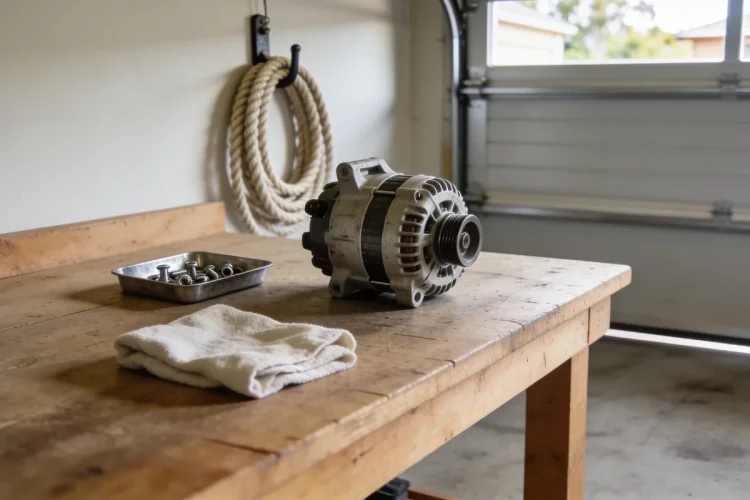
A used alternator at a fraction of the new price is a sensible buy, and most second-hand mechanical and body parts are a fair one. Two classes of part are different, because the thing a buyer needs to know about them cannot be seen. One is the airbag module or inflator. The other is the seat belt.
Our position, stated plainly. Buy most used parts from a wrecker who gives you a written invoice that names the part and the donor vehicle. Do not buy an airbag module, an inflator or a steering wheel carrying an airbag unless the maker confirms the donor vehicle is clear. Buy a used seat belt only when the wrecker states the donor vehicle’s history in writing, and never one with a fired pretensioner. The title’s test is whether the seller can vouch for the part’s history.
This article gives you three things: the rule behind the airbag advice, a ruling on where the seat belt sources disagree, and a table that sorts common parts into reuse, check or skip.
A Wrecker Is a Business, So the Sale Carries Rights
A wrecker supplies second-hand goods in trade, so the sale is not a private one-off. That matters because the consumer guarantee of acceptable quality applies. The ACCC describes it as a product that is safe, durable and free from defects, judged against factors such as its age, its price, whether it was sold new or second-hand, and its appearance and finish. A used part is not expected to perform like a new one. It is expected to be safe and to suit the price and age.
A private one-off sale is different. Most guarantees do not apply to a sale between two people where the seller is not running a business. Title, undisturbed possession and no hidden debts or charges still do. If you are buying a part from a person and not a business, the protection is thinner, and the checks below matter more.
If you are browsing auto wrecker ads, you can ask for the guarantee’s protection, and the invoice is how you prove what you bought.
The Airbag Rule Sits in a Recall Notice, Not in a Forum Post
The airbag rule is in a legal instrument, so it is worth reading the instrument. It is the compulsory airbag inflator recall notice of 2018, made on 27 February 2018 by the Assistant Minister to the Treasurer under section 122 of the Australian Consumer Law, and commencing on 1 March 2018. The Federal Register lists a single version of it, the one as made, with no amendments.
The notice defines a “Spare Part” as an affected inflator, or a part containing an affected inflator, that is supplied in Australia. Section 5(13) then says, in the notice’s own words, that a person who, in trade or commerce, supplies airbags or airbag inflators “must not supply a Spare Part or install one in any vehicle” unless the act is specifically permitted by the notice and complies with its section 6.
Read plainly, that bars trade supply of an affected inflator, or a part containing one, except where the notice allows it. That is the notice’s wording, and we are not making a finding about any particular wrecker.
Two more sets of clauses show how the recall was meant to work. Under section 5(10) and (11), a person in that position who is or becomes aware that they hold a Spare Part must notify a supplier as soon as practicable, and must use best endeavours to identify whether any parts in their possession are Spare Parts, including by checking supplier recall details and the Product Safety Australia website. Under section 6(5) and (7), a removed affected inflator must be immediately quarantined, labelled and handled so it cannot be re-used for anything but testing, and ultimately destroyed or used in testing.
What the notice does not do matters just as much. It does not bar every used airbag. It bars affected inflators, and you cannot tell by looking at one whether it is affected. The ACCC’s page on the recall says buyers of second-hand parts, or of cars with retrofitted parts such as steering wheels, should check with the manufacturer, because the part may hold an inflator that was never replaced. The same page notes that its information is no longer updated, though it remains relevant. Under section 8(2), a vehicle maker must keep a recall database on its website where a consumer can enter a VIN and see immediate information about that vehicle’s recall status.
Our call, which is advice and not a legal prohibition: skip a used airbag module, an inflator, or a steering wheel or dash carrying an airbag, unless the maker confirms the donor vehicle’s VIN is clear. The check takes a few minutes. The risk it removes is one you cannot inspect for.
Seat Belts: Some Posts Say Illegal, the State Pages Say Not Quite
Some online posts say that selling a used seat belt is unlawful, sometimes with a list of states. The two state pages we opened say something narrower, and the ruling here is that the sources turn on condition and history, not on a blanket ban.
Western Australia’s Department of Transport bulletin IB-113B says it is not illegal to use second-hand seat belts in good condition to replace worn and damaged ones. It then adds that a belt worn during a crash is not in good condition and must not be re-used. The bulletin’s last-updated line reads 1 May 2015. It is the clearest official wording we found, and it is an information bulletin, not a statute.
The reasoning is mechanical. Seat belts are designed to work effectively only once. Damage to the webbing and the mechanism is often invisible to the eye, and a cut as small as 5 millimetres can reduce a belt’s performance significantly. Pyrotechnic buckle pretensioners can only function once, and after one has fired the entire seat belt assembly must be replaced.
The bulletin lists the disadvantages of used belts: they may have missing essential parts, they carry no recognised warranty in relation to their safety performance, and they lack installation instructions. For a belt from a motor vehicle auto parts recycler, it says you should ask whether they have checked the assembly and its associated components before the sale, and that the supplier should know the belt’s crash history. A belt that fails should have its webbing cut through before the assembly is discarded.
South Australia’s seat belt safety page, last updated on 13 April 2023, says all seat belts should be original equipment as installed by the vehicle maker, or compliant replacements. Where a pyrotechnic buckle pretensioner has fired, both the buckle and the belt assemblies must be replaced. That page does not address second-hand belts.
A belt can also fail before it is ever second-hand. A Product Safety Australia alert published on 20 December 2018 concerned aftermarket belts that were not supplied with new vehicles as original equipment and were sold as replacements and for retrofitting vans and buses. The advice was to stop using them, and not to drive if the driver’s belt was affected. A used belt of unknown origin can carry that problem as well as a crash history.
The practical reading, then: a used belt in good condition is not unlawful in the pages we opened, a crash-worn belt must not be re-used, and a crash history is exactly what a buyer cannot see. So ask the wrecker for the history in writing, and walk away without it.
One limit. We opened only two state pages, Western Australia and South Australia, and found no transport authority page for other states on used belts. Ask your own state’s transport authority before you rely on this, and treat any state-by-state claim you meet elsewhere as unverified.
A Reuse, Check or Skip Table by Part
| Part | Call | Why |
|---|---|---|
| Body panels, bumpers, mirrors, lights | Reuse | No restraint role. Check fit and damage |
| Engine, gearbox, alternator, starter, water pump | Check | The invoice names the part and the donor vehicle. The guarantee of acceptable quality applies to a business sale, judged on age, price and second-hand status. Get return terms in writing |
| Seat belt assembly | Check the history, or skip | WA: a crash-worn belt must not be re-used, there is no recognised warranty, and the recycler should be asked. SA: original equipment or compliant replacements |
| Fired pretensioner or deformed stalk | Skip | WA and SA: the entire assembly, or both buckle and belt, must be replaced |
| Airbag module, inflator, steering wheel or dash carrying an airbag | Skip unless the maker confirms | Recall notice s 5(13) and the “Spare Part” definition. You cannot see an affected inflator. ACCC: check with the manufacturer |
How the calls were made. The seat belt, pretensioner and airbag rows rest on the pages cited above. The mechanical and body rows are our judgement, and they lean on the guarantee wording alone. They are a starting point for a conversation with the seller, not a rule.
What the Invoice and the Questions Should Cover
The invoice is where a used part becomes a part you can claim on. Ask for these items on it:
- the part named plainly
- the donor vehicle’s make, model, year and VIN
- the date and the price
- the return or warranty terms in writing
The VIN line deserves a note. We found no rule that requires a wrecker to put the donor vehicle’s VIN on an invoice, so this is our advice and not a requirement. We ask for it because it is the only way to check the recall status with the maker and to ask about the vehicle’s history.
Ask whether the part came from a crash vehicle. For any restraint part, ask for the history in writing, and treat a refusal as the answer. Keep the invoice, because it is your evidence in a guarantee claim. Ask the repairer who is fitting the part what they will and will not install. Mechanics and auto repair ads can help you find one, and the car parts and accessories category is another place to compare supply.
The guarantee does not make a bad part good, but the invoice gives you something to take back to the seller.
Where a Used Part Earns Its Place
Used mechanical and body parts earn their place because the price is lower, and a business sale carries the guarantee of acceptable quality. Used restraint parts earn it only when the history can be proven. The recall notice bars trade supply of an affected inflator, an affected inflator cannot be identified by looking, and the ACCC’s advice is to check with the maker. The state pages do not make a used belt unlawful in good condition, but they do say a crash-worn belt must not be re-used, and crash history is the thing a buyer cannot see.
The fair point to the cheap-parts side is real. A belt in good condition is lawful in the pages we opened, and the guarantee protects a business sale. Our answer is the test in the title: if the seller can vouch for the part in writing, the part can earn its place. If they cannot, it should stay on the shelf.
The routine is one line. Invoice, VIN, and history for anything that restrains you.
Sources: Federal Register of Legislation, compulsory airbag inflator recall notice made on 27 February 2018, F2018L00165 (https://legislation.gov.au/F2018L00165/asmade/2018-02-28/text/original/pdf); Product Safety Australia, About the compulsory airbag inflator recall (https://www.productsafety.gov.au/node/18281); Western Australian Department of Transport, Seat Belt Replacement, Information Bulletin IB-113B (https://www.transport.wa.gov.au/mediaFiles/licensing/LBU_VS_IB_113.pdf); South Australian Government, Seat belt safety (https://www.sa.gov.au/topics/driving-and-transport/vehicles/vehicle-standards-and-modifications/seat-belt-safety); Product Safety Australia, Product safety alert on aftermarket seat belts, 20 December 2018 (https://www.productsafety.gov.au/node/19014); Australian Competition and Consumer Commission, Consumer rights and guarantees (https://www.accc.gov.au/consumers/buying-products-and-services/consumer-rights-and-guarantees)


