 Places
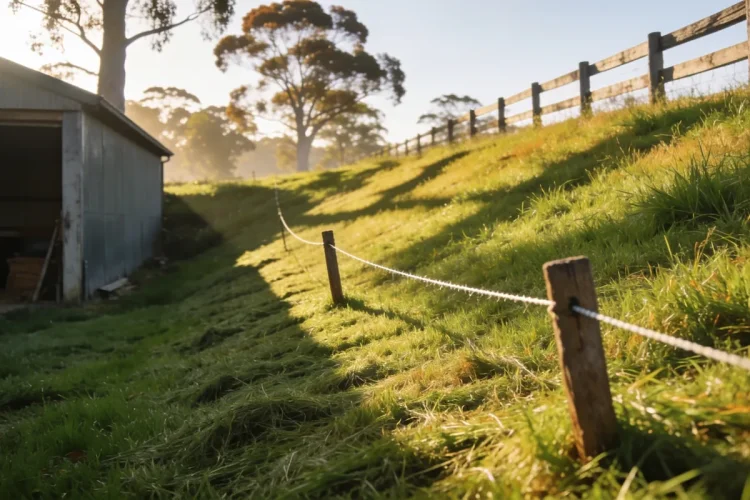
The ad says runs great. Wide cut, fair price, one photo of the front with the bonnet and the steering wheel. What it never shows is the back of the seat, and that is where the decision sits.
Here is the verdict. On a flat block, a used ride-on mower is a fair buy. On any block with a real slope, walk away from one with no rollover bar behind the seat and no seatbelt. And even with both, mow only within the gradient in the manual. Product Safety Australia, the national regulator, reports hundreds of ride-on mower injuries and, on average, two deaths a year. There is no mandatory safety standard for these machines. So the checking falls to you, and it has to happen before the cash changes hands.
Why the Slope Decides the Risk
Ask what the ground might do to the mower, not what the mower might do to the lawn.
WorkSafe Victoria’s rollover guidance, reviewed on 23 September 2024, lists where the risk runs high: steep slopes, uneven ground such as embankments, long grass that can hide obstacles, and wet grass, which cuts traction. The injury happens when the operator loses control, is thrown, or is crushed between the mower and the ground. Speed is not on that list of conditions, although both regulators still say to drive at a safe speed.
SafeWork SA makes the same point in a notice dated 16 February 2023. Slopes, drop-offs, ditches, embankments and edges are major factors in loss-of-control and tip-over incidents, and it notes that a worker died in October 2022 when a ride-on mower tipped on sloping ground. It adds that a ride-on can roll and trap or crush the rider even at slow speed.
Both of those pages are written for workplaces. The physics is the same in a backyard, though, and Product Safety Australia is the regulator who speaks to households.
So measure your slope. Do not eyeball it. WorkSafe Victoria suggests a phone angle app held against a straight edge, or a string line pulled between two pins. The same page gives workplace guidance limits for mowing: 5 degrees sideways, 10 uphill and 15 downhill. It lists those only for use where safer controls are not reasonably practicable, and it does not tie them to any standard or manufacturer, so treat them as guidance, not law. The number that matters most is the rated gradient in the manual for the machine you are buying, because Product Safety Australia says each mower’s rating is different and the manual is the one to follow. No manual with the machine means no rated gradient, and you are guessing.
Look Behind the Seat
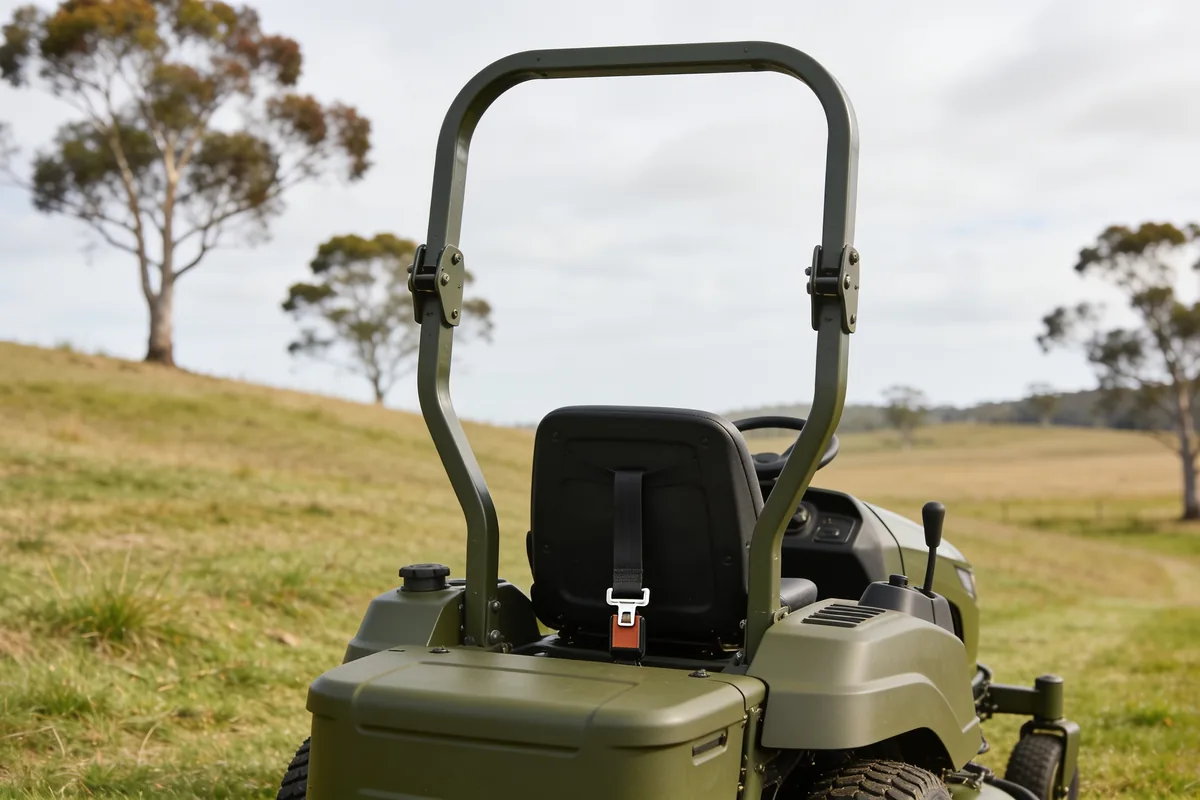
The thing to find is called a rollover protective structure. In plain terms, it is a bar or frame standing up behind the seat. WorkSafe Victoria says that if a ride-on is used, the structure should be secured in the up position, and the seatbelt worn with it. If the bar folds, a folded bar protects nobody, so check it stands up and stays up.
The belt belongs with the bar. Product Safety Australia’s advice is to wear a seatbelt if the mower has a rollover protection system. WorkSafe Victoria adds that a sequential interlocked seatbelt only lets the mower start once the belt is correctly secured, which is a good sign if you see one.
Now the awkward part. WorkSafe Victoria notes that traditional ride-ons are typically not fitted with a rollover protective structure. So a plain-looking mower with no bar is not a rarity. It is common, and it tells you nothing about whether the seller looked after it.
The standard does not rescue you either. The regulator recommends choosing a mower built to ISO 5395-3, the standard for ride-on lawnmowers with a seated operator, but that standard is voluntary. A mower meeting it is a good start, and a mower that does not mention it is not a crime. In both cases you check the machine and read the manual.
Three questions to put to the seller, before the engine ever gets started:
- Is there a rollover bar?
- Does it lock in the up position?
- Does the seatbelt work, and does the mower refuse to start until it is done up?
If the answers are vague, take the ute home empty.
Which Mower Tips Which Way
There is no safe type. They tip in different directions.
| Mower type | Highest risk | What a used one needs |
|---|---|---|
| Traditional ride-on | Overturning onto its side across a steep slope. Typically not fitted with a rollover protective structure | Ask the three bar-and-belt questions. Keep it off steep cross-slopes |
| Front mower | Overturning onto its side across a steep slope | Same checks. Mow with the slope in mind, not by habit |
| Zero-turn | Backflipping going up a steep slope. Two-wheel drive means less traction | Treat any steep uphill run with suspicion. Confirm the protection and the brakes |
| Stand-on | Backflipping going up a steep slope | Same as the zero-turn |
Source for the table: WorkSafe Victoria’s guidance, reviewed 23 September 2024.
A buyer might assume a zero-turn is the modern, stable choice and ask only what to check on a used one. WorkSafe Victoria says otherwise. A zero-turn or stand-on mower carries the highest backflip risk going up a steep slope and has less grip, while a traditional ride-on or front mower carries the highest risk of a sideways overturn. Different failure, same outcome. No type earns a pass.
Now put your block against the machine.
| Your block | What to do |
|---|---|
| Flat | A fair buy. Still check the bar and the belt, and still read the manual |
| A slope, and the mower has a bar and a working seatbelt | Possible. Mow only within the manual’s rated gradient, and get a dealer to inspect it first |
| A slope, and the mower has no bar and no seatbelt | Walk away |
| A steep bank or a drop-off | Do not ride a mower there at all. See the alternatives below |
A cheap mower that cannot be used safely on your block is not cheap.
The Checks That Come After the Bar
A bar and a belt are the gate. Once the mower is through it, there is a short list left.
Get an authorised dealer to inspect it. This is the regulator’s own advice for a second-hand mower: have an authorised dealer look it over to make sure the safety equipment works properly. It costs money, so put it in the deal. Price the extras in before you agree, the way a used split system has to carry its reinstall cost. The sticker is not the whole bill.
Check the blades stop when you reverse. Product Safety Australia suggests looking for a design that stops the blades cutting while reversing. Ask the seller to show you.
Check brakes, steering and tyres. WorkSafe Victoria recommends inspecting all three to the manufacturer’s recommendations, including tyre pressure and tread. Worn tyres on a slope are a bad bet.
Test it at the seller’s door. The habit is the same as with second-hand power tools: the checking happens before the money moves, never after. Start it, drive it, stop it, and try the belt and the bar while the seller is standing right there.
Buy from a reputable supplier where you can. That is Product Safety Australia’s advice. It does not rule out a private sale, but a private seller who cannot answer the bar-and-belt questions has already told you something.
Plan the first run before you buy. Before a steep slope, WorkSafe Victoria says to test the brakes and make sure there is a clear path straight down the slope, free of obstacles, in case the brakes fail. If you cannot picture a safe line across your own block, the problem is the block, not the machine.
Keep the list short at the door. Bar up and locked, belt working, blades stop in reverse, brakes, steering, tyres, manual in hand. Anything missing is a walk-away or a lower price, and you decide which before you arrive.
Mind the operator. Product Safety Australia says children under 16 should not operate a ride-on mower, and that children should always be kept away from ride-on mowers. Never go downhill with the gearbox in neutral, either, which is another line from the same guide.
The Fair Point for the Other Side
Some buying guides treat a used ride-on as a mechanical purchase: engine, leaks, tyres, deck rust, service history. Some say a used machine is the sensible way in because new ones cost so much. That is a fair point, and on a flat suburban block it holds. A cheap, sound, dealer-inspected ride-on with a careful driver is good value.
The regulators see it as a rollover purchase, and so do we. A bar and a belt lower the risk. They do not remove it.
If your block is steep, the cheaper and safer answer may not be a ride-on at all. WorkSafe Victoria lists the alternatives: change the slope to a ground cover that does not need mowing, bring in goats, or use a push mower, a self-propelled walk-behind, a brush cutter or a robotic mower. Finding the right machine for the right ground is half the job, and the for-sale ads are a good place to start.
Measure the Block First
A used ride-on mower is a fair buy on flat ground and a risk on a slope, and the back of the seat tells you which one you are looking at. Before you contact a seller, get a string line and two pegs, and measure the steepest part of your block. If it is more than the manual allows, or the mower has no bar and no belt, walk away. Another ad will come along.
Sources: Product Safety Australia, Ride-on lawn mowers guide (https://www.productsafety.gov.au/consumers/be-safe-around-the-home/use-garden-and-outdoor-products-safely/ride-on-lawn-mowers-guide); WorkSafe Victoria, Preventing ride-on lawn mower rollover (https://www.worksafe.vic.gov.au/preventing-ride-lawn-mower-rollover); SafeWork SA, Don’t cut corners with ride-on lawnmower safety (https://www.safework.sa.gov.au/news-and-alerts/news/news/2023/dont-cut-corners-with-ride-on-lawnmower-safety)


